Safe Load Indicator Vs Load Moment Indicator: What’s the Difference?
In modern lifting operations, safety and load control are critical. Cranes are designed to lift heavy loads, but even a small miscalculation can lead to serious accidents such as crane tipping, structural damage, or injuries to workers.
To prevent these risks, safety monitoring systems like Safe Load Indicators (SLI) and Load Moment Indicators (LMI) are widely used in cranes and lifting equipment. While these terms are sometimes used interchangeably, they actually have different functions and levels of safety monitoring.
Understanding the difference between these two systems can help organizations choose the right safety solution for their lifting operations.
What is a Safe Load Indicator (SLI)?
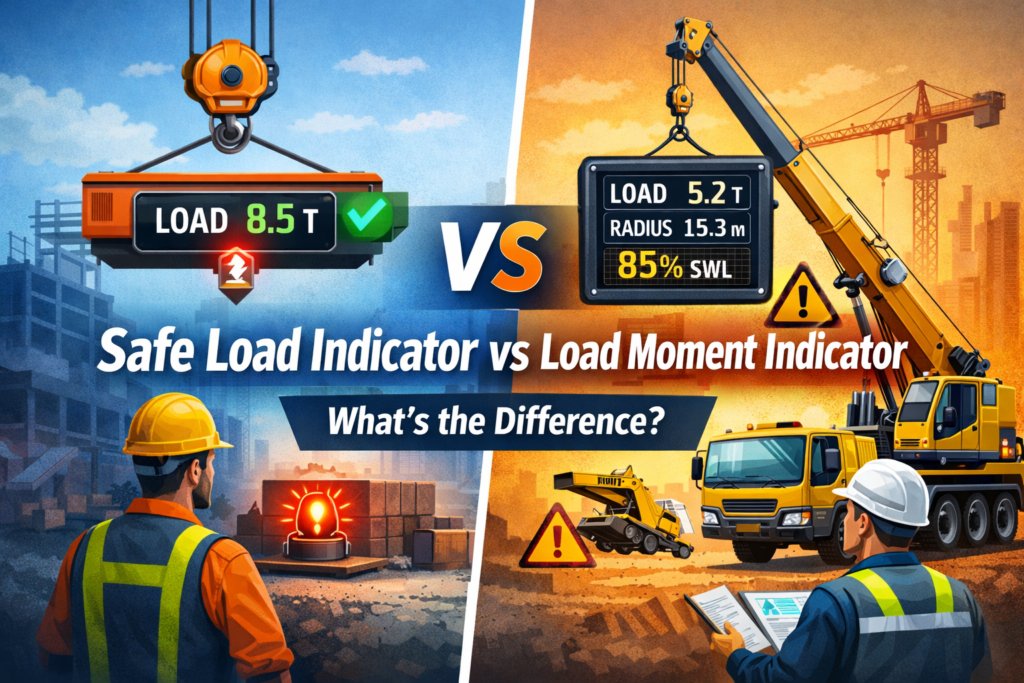
A Safe Load Indicator (SLI) is a safety device used in cranes and lifting equipment to measure and display the load being lifted. It helps operators ensure that the load does not exceed the crane’s Safe Working Load (SWL).
The system typically measures load through sensors installed on the crane and displays the load information on a screen in the operator’s cabin.
Key Functions of a Safe Load Indicator
- Displays the actual load being lifted
- Warns the operator if the load approaches the maximum safe limit
- Provides audible and visual alarms during overload situations
- Helps operators make safer lifting decisions
Where SLI is Commonly Used
Safe Load Indicators are commonly used in:
- Overhead cranes
- Winches
- Hoists
- Material handling equipment
- Industrial lifting systems
SLI systems are effective for basic load monitoring, especially in operations where the crane radius does not change significantly.
What is a Load Moment Indicator (LMI)?
A Load Moment Indicator (LMI) is a more advanced crane safety system that monitors multiple parameters during lifting operations. Instead of only measuring the load weight, it calculates the lifting moment, which is the combination of load weight and crane operating radius.
This calculation is crucial because the stability of a crane depends not only on the weight of the load but also on how far the load is from the crane’s center of rotation.
Key Functions of a Load Moment Indicator
- Measures load weight
- Monitors boom length
- Calculates operating radius
- Determines the actual load moment
- Provides warnings and automatic shutdown in dangerous conditions
Where LMI is Used
Load Moment Indicators are commonly installed in:
- Mobile cranes
- Tower cranes
- Hydraulic cranes
- Crawler cranes
- Telescopic cranes
These cranes operate with varying boom lengths and working radii, making advanced load monitoring essential for safety.
Key Differences Between SLI and LMI
Feature | Safe Load Indicator (SLI) | Load Moment Indicator (LMI) |
Primary Function | Measures load weight | Calculates load moment (weight + radius) |
Monitoring Level | Basic load monitoring | Advanced crane safety monitoring |
Parameters Measured | Load weight | Load, radius, boom length, crane configuration |
Suitable For | Hoists, winches, overhead cranes | Mobile cranes, tower cranes |
Safety Capability | Prevents overloading | Prevents tipping and overload conditions |
Why Modern Cranes Prefer LMI Systems
In many modern lifting operations, Load Moment Indicators are preferred because they provide a more complete safety solution.
A crane may be lifting a load within its weight limit, but if the working radius increases, the crane can still become unstable. LMI systems continuously monitor these parameters and provide warnings before the crane reaches a dangerous condition.
This level of monitoring significantly reduces the risk of:
- Crane tipping accidents
- Structural damage to equipment
- Costly project delays
- Worker injuries
The Role of Smart Load Monitoring Systems
With advancements in safety technology, modern load monitoring systems now offer:
- Real-time load monitoring
- Digital display units
- Audible and visual alarms
- Data logging and diagnostics
- Integration with crane control systems
These technologies help organizations maintain higher safety standards and operational efficiency.
How Load Sense Solutions Supports Safer Lifting Operations
Load Sense Solutions designs and manufactures advanced crane safety and load monitoring systems that help industries operate lifting equipment safely and efficiently.
Our systems provide:
- Accurate load monitoring
- Reliable overload warning systems
- Robust industrial-grade sensors
- Easy installation and user-friendly display units
- 24/7 global technical support
Our solutions are widely used in industries such as construction, logistics, ports, and heavy engineering, where lifting safety is critical.
Conclusion
Both Safe Load Indicators (SLI) and Load Moment Indicators (LMI) play an important role in improving crane safety. While SLI systems provide basic load monitoring, LMI systems offer advanced safety by calculating the complete lifting moment.
For modern cranes operating in dynamic environments, Load Moment Indicators provide a higher level of safety and operational control.
Investing in reliable load monitoring technology not only protects expensive equipment but also ensures the safety of workers and lifting operations.